The Third Man Syndrome

Who is the third who walks always beside you?
When I count, there are only you and I together
But when I look ahead up the white road
There is always another one walking beside you
Gliding wrapt in a brown mantle, hooded
I do not know whether a man or a woman
But who is that on the other side of you?
T.S.ELIOT, THE WASTELANDS, 1922

Shackleton was tired, scared. But, never disappointed. He was facing one of the most devastating turn of events in his exploration of South Pole in 1919. Around him snow blew sideways in great white sheets, like ghosts swirling through the air. The wind screamed so loudly that it seemed to cut straight into our skulls. Every step felt like they were lifting their legs through wet cement—only colder.
“Keep moving!” Shackleton’s voice was hoarse, but steady.
It was the voice of a man who refused to let despair take hold. He had two companions with him: Tom & Frank. Tom and Frank plodded alongside him, each man hunched beneath the weight of exhaustion and the bitter Antarctic cold.
The three of them had already endured months of hardship. Their ship, the Endurance, had been trapped and crushed by ice. The rest of their crew was still stranded hundreds of miles away, clinging to hope that their leader would return with help. Shackleton and his two companions had only one option: cross the uncharted, jagged mountains of South Georgia Island to reach a whaling station in Stromness Bay. It was a 24-mile journey, but in those conditions, it might as well have been a thousand.
Their clothes were stiff with ice. They hadn’t slept in nearly two days.
Then, something strange happened. Shackleton felt a fourth presence. Not a shadowy figure exactly, but a steadying sense—like a hand was at his back, pushing him onward. He said nothing to the others, but the feeling was undeniable.
But, this strange fourth person did not speak anything. He was not scary. He was not angry. In some way, Shackleton felt comfortable in the presence of this fourth person. The fourth person felt like a long lost relative, who was supporting Shackleton to keep moving. When they finally reached Stromness Bay, thirty-six hours after they had set out, the men collapsed into the safety of the station.
“I know it sounds crazy, but I have to tell you something guys.”, said Shackleton.
“I felt like someone was walking besides us. I turned to look many times, but there was nobody. But, when I was walking forward, I felt like I was being followed. I don’t know how to explain it…”
Later, Tom and Frank would quietly admit they had felt it too: someone else had been with them, guiding them through the worst of it .
NOT AS RARE AS YOU MAY THINK
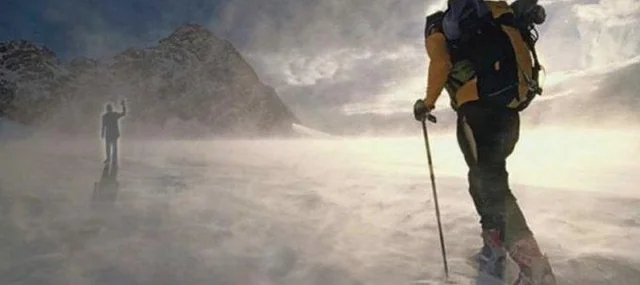
While Shackleton’s 1916 Antarctic ordeal is one of the most famous stories of a mysterious “extra companion,” it’s far from the only one. Many explorers, mountaineers, sailors, soldiers, astronauts, and disaster survivors have reported a similar phenomenon.
This experience has a name: The Third Man Syndrome (or the “Third Man Factor”). It describes the sudden awareness of an unseen presence that offers guidance, comfort, or encouragement in extreme survival situations.
People from vastly different backgrounds— whether climbing icy peaks in the Himalayas, drifting in the middle of the ocean, or escaping from war zones—describe feeling they are not alone, even when no other living person could be there.
Some say this “third man” gives them step-bystep instructions to safety. Others feel only a calm reassurance that they will survive. And intriguingly, the presence often appears without being called for, and vanishes as soon as danger passes.
This experience was captured in 1922 by T.S.Eliot in his poetry The Wastelands.
Note that even if it is a fourth person, or a second person, the phenomena is still called as the Third Man Syndrome.
Let us look at two more stories of such experiences.
Joe Simpson – The Andes Escape

Joe Simpson is one of the best climber the world has seen. He has described his experiences in his phenomenal book (and recommended by The Explorer Team as TBR) “Touching The Void”. One of the experiences he clearly mentions is of a third person. He wrote,
“As we were climbing the jagged peaks of the Peruvian Andes, the wind was screaming all around us. Far below, glaciers were splitting and creaking. Simon, my climbing partner, and I were on our way down from the Summit of Siula Grande, a 21,000 foot mountain.
Then, I fell. I slipped, smashed my leg in a way that walking was nearly impossible. The pain was so sharp that if seemed to flood my entire body. I was hanging down the cliff, with my rope attached to Simon. Simon couldn’t see me. He tried calling my name, but the wind drowned his scream.
He assumed I was dead. And he cut the rope while I was still hanging by the cliff.
I tumbled into the dark mouth of a creavasse. The cold there was different—it didn’t just freeze the skin; it swallowed the air, the light, and the will to move.
With my leg ruined, I began to crawl. Hours blurred into days. My world narrowed to ice, snow, and the crushing pain in my body. But then, something remarkable happened. A calm, patient presence seemed to settle beside me —not visible, not speaking aloud, but urging him forward in simple steps:
rest now… move now… drink water… keep going.
Every time I thought he couldn’t go on, that presence seemed to keep me from giving in. Against all odds, I crawled back to base camp, gaunt and frostbitten but alive.”
The Twin Towers, 9/11
On September 11, 2001, several survivors of the World Trade Center collapse reported feeling a similar guiding presence. One survivor said that while trapped in the dust and chaos, she felt a “hand” guiding her toward an escape route. Another described a voice telling him to “keep going, don’t stop,” even when he felt exhausted. These survivors believed the presence was responsible for leading them to safety through the darkness.

What does the Literature Say?
Canadian author John Geiger explored this phenomenon in his book The Third Man Factor: Surviving the Impossible. He found countless similar cases—mountaineers lost in storms, sailors adrift at sea, pilots in failing aircraft, and even astronauts in dangerous space missions.
In Geiger’s research, a few patterns emerged:
The phenomenon often happens in life-or-death situations.
Survivors describe the presence as calm, encouraging, and authoritative.
Sometimes, the presence feels like a deceased loved one or even a historical figure.
Most people don’t realize until after ward that others with them felt it too.
Geiger wasn’t the first to record it—explorer accounts, polar expedition journals, and even war diaries have documented similar mysterious companions. The descriptions vary, but the impact is always the same: a sudden boost in hope, focus, and willpower to survive.
The Spiritual View
For many, this presence is interpreted as a guardian angel or spiritual protector. In religious traditions, angels or benevolent spirits are believed to guide people through danger. Some see it as the souls of departed loved ones returning to help in a moment of need. Others interpret it as divine intervention—a higher power ensuring survival.
Survivors often describe a feeling of deep peace alongside the presence, even when the situation is terrifying. To them, the experience isn’t just psychological—it’s sacred.
The Scientific View
Scientists, however, see it differently. Psychologists suggest the Third Man is a coping mechanism of the human brain. In extreme danger, especially when suffering from exhaustion, hunger, cold, or sensory deprivation, the mind may create a “helper figure” to keep the body going.
This could be linked to what’s called the bicameral mentality—a theory that early humans once experienced their thoughts as external “voices” before developing self-awareness
Other theories
Neurological stress responses: The brain produces hallucinations under extreme duress.
Self-talk personified: Survival instincts split into a separate “voice” to motivate action.
Sensory deprivation effects: With limited input from the outside world, the brain fills in the gaps.
Interestingly, modern therapy sometimes uses this idea to help trauma survivors—guiding them to imagine a strong, supportive “third man” to help them through anxiety or flashbacks.
Even with science, history, and literature all exploring the Third Man Syndrome, the truth is… we still don’t know exactly what it is.
Is it a guardian angel? A trick of the mind? Or something we can’t yet explain?
For Shackleton, Joe Simpson, and countless others, the answer didn’t matter in the moment. What mattered was that the presence helped them live.
Perhaps one day, science will have a clear explanation. Or maybe this is one of life’s mysteries we’ll never fully solve—a reminder that in our darkest hours, help can come from places we least expect.


Comments