Symbiotic Relationships in Wildlife

Humans need other humans to survive. Humans are social animals after all. But it turns out that “You scratch my back, and I scratch yours” also applies to the animal world, sometimes in the most literal sense. Not only within their own species, animals have evolved relationships that benefit one another. The trouble of one species can become an opportunity for another, and vice versa. We call such interactions symbiotic relationships.
Let us look at some fascinating examples of symbiosis in the animal world.
#1 Oxpeckers and Large Mammals
Oxpeckers are among nature’s most interesting birds. Instead of searching for food in the wild, they often find meals while sitting on the bodies of large mammals such as buffaloes, rhinos, giraffes, zebras, and hippos. These animals can carry ticks, flies, mites, and other parasites on their skin, providing a ready food source for the birds.

Oxpeckers have strong claws that allow them to cling securely to moving animals, while their stiff tail feathers help them maintain balance.
Many cattle-farming communities in Africa appreciate oxpeckers because they remove parasites from livestock. Two species are common: the Red-billed Oxpecker and the Yellow-billed Oxpecker, which are similar in appearance except for the colour of their beaks.

Scientists once believed that oxpeckers were purely beneficial, but research has shown that the relationship is more complex. While they remove parasites, they may also feed on blood from existing wounds and sometimes keep wounds open longer than they otherwise would. Nevertheless, the birds gain food and the mammals often benefit from parasite removal.
Are they helping because they are kind-hearted birds? Probably not. They are simply looking for food, and a healthy host provides a steady supply.
#2 Termites and Protists
Termites are famous for feeding on wood. Wood contains cellulose, a tough plant material that most animals cannot digest. Surprisingly, termites themselves cannot digest cellulose without help.

Inside the guts of many termite species live microscopic organisms called protists. These protists produce enzymes that break down cellulose into nutrients that termites can absorb. In return, the protists receive food and a safe place to live.
(Image Source: Springer Nature)
This relationship is so important that termites cannot survive without their gut microorganisms, and the protists cannot survive outside the termite gut. It is one of the best examples of mutualistic symbiosis, where both partners benefit.
#3 Crocodiles and Plover Birds: A Popular Story
A famous story claims that plover birds, sometimes called “crocodile birds,” enter the mouths of crocodiles and eat scraps of food stuck between their teeth. In return, the crocodile supposedly receives a free dental cleaning.

However, there is a problem: scientific evidence for this behaviour is extremely limited. The story dates back to ancient writings by the Greek historian Herodotus, but modern researchers have found little proof that this regularly occurs in nature.
While it remains a fascinating tale, scientists generally regard it as a myth or, at best, a very rare behaviour that has not been well documented.
#4 Goby Fish and Pistol Shrimps
Some species of pistol shrimps have very poor eyesight and are vulnerable to predators. To stay safe, they dig burrows in sandy seabeds.
Goby fish, on the other hand, have excellent eyesight but cannot dig burrows efficiently. As a result, the two animals often form partnerships.
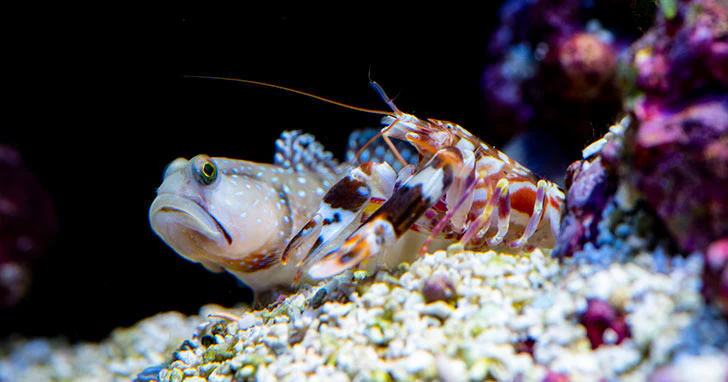
The shrimp builds and maintains the burrow, while the goby stands guard at the entrance. The shrimp usually keeps one antenna in contact with the goby. If danger approaches, the goby flicks its body or darts into the burrow, signalling the shrimp to retreat as well.
Both animals benefit: the goby gains a secure home, while the shrimp gains an early-warning system against predators.
#5 Acacia Trees and Ants
The alliance between certain East African acacia trees and ants is one of the most remarkable examples of cooperation in nature.
The trees cannot easily defend themselves against insects or large herbivores that feed on their leaves. Instead, they provide shelter and food for aggressive ant species.

The acacia produces swollen thorns that act as homes for the ants and provides sugary nectar and nutrient-rich food bodies. In return, the ants aggressively attack insects, remove competing plants, and even drive away much larger animals that attempt to eat the tree’s leaves.
Both species benefit greatly from the partnership, making it a classic example of mutualism.
Nature is filled with partnerships that show how survival is often a team effort. From termites relying on microscopic gut organisms to goby fish sharing homes with shrimps, symbiotic relationships demonstrate that cooperation can be just as important as competition in the natural world. These relationships remind us that even vastly different species can thrive when they work together.
References
Berenbaum, M. R. (2023). Bugs in the system: Insects and their impact on human affairs. Oxford University Press. Britannica. (2025). Symbiosis. Encyclopaedia Britannica. https://www.britannica.com/science/symbiosis
National Geographic Society. (2023). Symbiosis. https://education.nationalgeographic.org/resource/symbiosis/
Smith, S. M., & Douglas-Hamilton, I. (1967). The benefits of oxpeckers to mammals. Behaviour, 27(1–2), 11–25. https://doi.org/10.1163/156853967X00021
Zimmer, C. (2014). The termite's secret weapon: Microbes. The New York Times. https://www.nytimes.com/2014/08/12/science/the-termites-secret-weapon-microbes.html
Palmer, T. M., Stanton, M. L., Young, T. P., Goheen, J. R., Pringle, R. M., & Karban, R. (2008). Breakdown of an ant-plant mutualism follows the loss of large herbivores from an African savanna. Science, 319(5860), 192–195. https://doi.org/10.1126/science.1151579


Comments