How Reflections & Refractions Work?

One rainy afternoon, Maya was walking home from school when the clouds broke and a rainbow appeared. Seven perfect colors arched across the sky. “How does light make that?” she wondered.
Centuries ago, another curious mind had the same question — Isaac Newton.
People believed rainbows were just a trick of the clouds, but Newton wanted proof. He took a beam of sunlight and passed it through a glass prism.

To his surprise, the light spread into seven brilliant colors, just like a rainbow in the sky. Newton had discovered that white light is made of many colors — and that glass, water, and even raindrops can split and bend light in amazing ways.
What is Reflection?
Imagine throwing a rubber ball at a wall. If you throw it at a certain angle, it bounces back at the exact same angle. (see the image on next page) That’s how light behaves when it hits something shiny like a mirror — it bounces back. The angle it comes in at (the angle of incidence) is exactly equal to the angle it goes out at (the angle of reflection).

It’s why you can see yourself in a shop window or use a mirror to peek around a corner — light is simply bouncing straight back to your eyes, playing a game of “return the ball.
What is Refraction?
Now imagine you have a tennis ball, and you roll it on a concrete road. It’s rolling in a straight line as expected. But, suddenly, grass patch comes in its path. The moment it hits the grass, it slows down and changes direction. Light does something similar when it travels from one material into another — like from air into water or from air into glass.
The change in speed makes it bend. This bending is called refraction, and it follows a rule called Snell’s Law. It’s why a pencil in a glass of water looks bent, and why fish in a pond aren’t exactly where they appear. Raindrops high in the air use refraction to split sunlight into rainbows — the very thing Newton studied .

Why does this matter?
Reflection and refraction aren’t just cool science words — they’re everywhere in your life. Reflection helps you comb your hair in the morning, but it also lets scientists measure the distance to the Moon by bouncing lasers off mirrors left there by astronauts.
Refraction makes a straw look crooked, but it’s also how submarines use periscopes to peek above the water, how doctors guide tiny cameras inside the body, and how telescopes bend starlight to reveal galaxies billions of light-years away.
From spotting a rainbow on your way home to guiding a spacecraft across the solar system, these two simple tricks of light help us see, measure, explore, and understand the universe. Every bounce and bend tells a story — you just have to look for it.
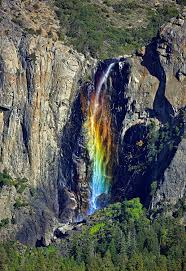
The above image is from Yosemite Falls in United States. You can see the refraction & reflection concepts at play here.
What ends up happening is that the water droplets coming out as mist from the waterfall start acting as prisms. The light gets into these tiny water particles from one side and exits as 7 shades of color from other side forming a beautiful rainbow.
Now, next time you see the rainbow, you’ll know why it is forming, won’t you?


Comments